


“O anu parallu paeng tawwa ampetakangi wilayah adatna jari ni assengi kana kemaea wilayahta segang apa-apa nia ilalang ri wilayah adatka kullei ni asseng apa kulle nikembangkan punna lekbamo ni petakan” (“Oh, it turns out we are mapping our customary territories, so that we know our customary territories and what is in our customary territories, and we can develop the potential of the customary territories that we have, which we can find out after mapping the customary territories,” said Norma of the Baliti Indigenous Women who was involved in the participatory mapping activity). Participatory mapping in the customary areas of Indigenous Peoples of Baliti, Bolaromang, and Suka help especially the younger generation and women, understand territorial boundaries, prevent conflicts with neighboring customary areas, identify resource potential, and recognize ancestral sites through intergenerational knowledge exchange. This initiative, covering 3,437.42 hectares and impacting 4,121 people also increases the confidence of indigenous communities by providing a strong foundation to manage and advocate for their rights over their customary territories.
This Indigenous Peoples is one example of the impact of direct funding that AMAN, KPA, WALHI have pioneered through the establishment of the Nusantara Fund since its launch in 2023. From December 2023 – June 2026, the Nusantara Fund has distributed funding directly to 577 initiatives of Indigenous Peoples, Peasants, Fisherfolk, Women, and Youth relevant to the 5 main targets of the Nusantara Fund spread across 35 Provinces (out of a total of 38 Provinces) in Indonesia. The total amount that has been distributed to date is 51 billion Rupiah (USD 3.4 million).
Within a decade, Nusantara Fund aims to impact and improve the quality of life through direct funding for 30 million people (1/9 of Indonesia’s total population) including Indigenous Peoples, Fisherfolks, Peasants, Women, and Youth, with an impact on a total area of 30 million hectares (1/6 of Indonesia’s total land area) that has been mapped, socially and/or formally recognized, and rehabilitated. This achievement is driven by the achievement of the Nusantara Fund’s five main targets: (1) increase mapping of Indigenous Territory, Community-based Area Management, and Priority Location for Agrarian Reform by 20 million hectares; (2) increase protecting and recognizing of 7.8 million hectares of land; (3) rehabilitation and restoration of 3.5 million hectares of land; (4) the realization of various models of production, distribution, and consumption; and (5) the establishment of People’s Education Centers to revitalize, restore, innovate, and collaborate to improve knowledge, quality of knowledge, and skills in protecting and managing land, territories, and agrarian resources.
In February – June 2026, Nusantara Fund conducted an impact analysis of 2025 direct funding for 157 initiatives that had been reported. The impact methodology was agreed upon based on the Nusantara Fund’s 5-year strategic plan, and measured ecological, socio-political, and economic impacts qualitative and quantitatively. Complementary and verification data used data documented internally by AMAN, KPA, WALHI and secondary data from sources such as the Customary Territory Registration Agency (BRWA), tanahkita.id, lpra.kpa.or.id, and the Central Bureau of Statistics (BPS). From the analysis of 157 reports and documentation of Indigenous Peoples, Fisherfolks, Peasants,Women, and Youth, which have been carried out in 2025, it can be concluded that the impact of the five main targets of the Nusantara Fund so far is:
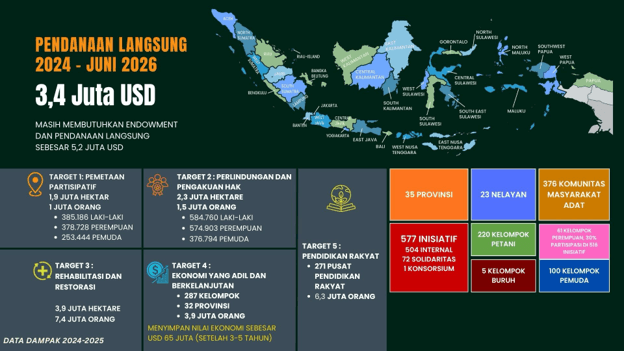
Target 1; The initiatives under Target 1 have impacted an area of 1.9 million hectares covering Indigenous Territory, Community-based Area Management (WKR), and Priority Locations for Agrarian Reform (LPRA), and have had a socio-political impact on 1 million people, consisting of 385,166 men, 378,728 women, and 253,444 youth. Participatory mapping clarifies the boundaries of indigenous territory, LPRA, and WKR, which strengthens community claims to ancestral lands and forests, their priority location of agrarian reform, and their community-managed area. The mapping enhances their legitimacy and collective identity. The resulting maps also serve as advocacy tools for agrarian reform, recognition of indigenous peoples’ rights, and protection of areas from threats from large-scale concessions such as mining, forestry, and national strategic projects.
Participatory mapping has strengthened communities’ collective identity and territorial rights by clarifying the boundaries of Indigenous territories, community-managed lands, and priority areas for agrarian reform that have been inherited and collectively managed across generations. By integrating local knowledge with modern cartographic techniques, the process transforms customary territorial knowledge into credible social and spatial data that strengthen communities’ legitimacy, increase their confidence in asserting territorial claims, and provide an effective means of communicating with external stakeholders. Beyond boundary delineation, participatory mapping also supports community-based land-use planning by identifying agricultural areas, forests, water sources, sacred sites, and other important landscapes, enabling more organized, long-term, and locally driven management of living spaces while promoting inclusive participation of women and youth in territorial governance and intergenerational knowledge transfer like in Indigenous Peoples of Baliti, Bolaromang, and Suka in Gowa, South Sulawesi.
At the same time, participatory mapping has become a powerful advocacy tool for securing the recognition and protection of community territories. Spatial data and maps have been used to address agrarian conflicts, challenge unilateral land claims, and resist environmentally harmful development projects. In several cases, participatory maps have contributed to formal state recognition of community-managed forests, resolved conflicts between communities and government agencies, and strengthened local resistance against large-scale development projects. By improving communities’ bargaining position in legal and policy processes, participatory mapping supports the protection of land rights, safeguards ecologically important areas such as forests, coastal zones, and water sources, and contributes to the conservation of biodiversity and the long-term sustainability of community livelihoods.
Target 2 has been achieved, with 2.3 million hectares of Indigenous Peoples, Peasants, Fisherfolks, Women, and Youth becoming more organized, solid, and confident in facing external pressures and negotiations with the government. LPRA map verification was carried out by the mapping team and members of community organizations. The initiatives in target 2 have impacted 1.5 million people, consisting of 574,903 women, 584,760 men, and 376,794 youth. Community advocacy for the recognition of Indigenous territories, community-managed lands, and priority agrarian reform areas strengthens communities’ collective land rights through organizing, capacity building, and legal advocacy. This process reinforces communities’ ability to defend their territories and livelihoods, reduces the risks of land dispossession, agrarian conflicts, and unsustainable natural resource exploitation, and provides greater tenure security, improved well-being, and enhanced access to livelihood opportunities. At the same time, the recognition process strengthens the organization, solidarity, and advocacy capacity of Indigenous Peoples, peasants, fisherfolks, women, and youth, fostering greater collective awareness and commitment to protecting their rights and sustaining their territories. For example the initiative of accelerating the recognition and protection of the territories of 29 Talang Mamak Indigenous communities in Indragiri Hulu Riau through a Regional Regulation at the Indragiri Hulu Regency level. This initiative has opening the collective awareness internally of Talang Mamak Indigenous Peoples in the process and strategy to reclaiming their ancestral land toward local government.
The recognition of community and Indigenous territories strengthens social and cultural identity by reinforcing traditional values, customary practices, and intergenerational systems of territorial governance. It also expands the participation of women and youth in advocacy and community decision-making, contributing to stronger local organization and leadership regeneration. Furthermore, the recognition process encourages communities to establish collective mechanisms for protecting their territories through customary governance, land rights reclamation, and community-based territorial management, thereby enhancing the sustainable and autonomous management of their livelihoods and living spaces.
Target 3 has achieved 3.9 million hectares of areas where rehabilitation and restoration of critical land has begun. The program in this target has an ecological impact on the restoration of forest ecosystems and water sources. Community-led restoration of Indigenous territories, community-managed lands, and priority agrarian reform areas has revitalized degraded forests, peatlands, coastal ecosystems, and agricultural landscapes through reforestation, ecological restoration, and natural farming practices within an agroecological framework that integrates ecological, social, and economic sustainability. These efforts have strengthened soil health, biodiversity, water conservation, and forest functions while reducing dependence on chemical inputs and promoting sustainable livelihoods. Restoration has also revived customary institutions, local knowledge, and cultural traditions, including the Kaliwu agroforestry system in the Wairasa Bali Indigenous community and East Sumba, the Sasi customary marine management system practiced by the Sarae Bura fishing community, the restoration of customary water governance in Pamona, and the protection of endemic timber species for ritual practices and traditional house construction in the Morekau Indigenous community. In addition, these initiatives have safeguarded critical water sources, mangrove ecosystems, and micro-hydropower resources, restored native tree species such as Uru and Buangin in the Se’seng Toraja Indigenous community, and protected habitats for endemic wildlife—including the Maleo, Bird-of-Paradise, Owa Jawa, Orangutan, Hornbill, Tiger, and Tapir—thereby enhancing ecological resilience, cultural continuity, and the long-term sustainability of community livelihoods.
Community participation in ecosystem restoration—particularly by youth and women—has strengthened collective environmental awareness, revived traditional ecological knowledge, and reinforced community responsibility for protecting living spaces and customary sites. Restoration efforts have been integrated into Indigenous schools, the ARAS program, and ecological academies, promoting the use of native plant species across diverse landscapes, seasonal calendars, and cultural practices closely linked to local history and spirituality. For example, youth in the Bulu Bulu community of South Sulawesi have expanded spring protection efforts by engaging visitors to an environmental education site and local government, while the AMMK women’s group in Aceh has strengthened collective action through pepper restoration initiatives. At the same time, ecosystem restoration—including peatland rehabilitation, sustainable agriculture, mangrove planting, coral reef restoration, and improved organic waste management—has enhanced communities’ resilience to climate change by reducing the risks of drought, peat fires, erosion, floods, landslides, coastal abrasion, and pollution, while increasing carbon sequestration, restoring marine and coastal habitats, strengthening local food systems, and promoting adaptive farming practices such as rainy-season replanting, simple irrigation, collective watering, shade-net use, and extended growing seasons.
Target 4 has been achieved by 287 collective economic unit groups in 32 provinces. The implementation has had a social impact on the economic equality of 3.9 million people who store economic value in long-term crops such as coffee, avocado, sugar palm, vanilla, nutmeg, cloves, chocolate, fruits, areca nut, coconut, rambutan, frankincense, rattan, bamboo (3-5 years) amounting to 65 million USD. Community-based economic initiatives have strengthened local livelihoods, economic sovereignty, and food security by developing local commodities such as rice, coffee, nutmeg, vanilla, cocoa, honey, fisheries, and livestock, while improving production infrastructure, including coffee processing houses, drying facilities, and storage warehouses, to increase product quality and market value. These initiatives also promote innovation and resource efficiency, as demonstrated by the Manggusta Indigenous Community in North Sumatra, which transforms corn cobs into affordable livestock feed for cattle and goats. By supporting household food production, compost use, and community-managed seed systems, these efforts reduce production costs and dependence on middlemen and moneylenders; for example, the Sambirejo Truth and Justice Forum in Central Java has enabled farmers to independently manage seed procurement, allowing economic benefits to remain within the community. Collective enterprises, cooperatives, and community businesses have further strengthened local solidarity and organizational resilience by generating shared resources to sustain Indigenous Peoples, farmers, fishers, women, and youth organizations. Notable examples include the Pari Island Women’s Group in Jakarta, which manages ecotourism enterprises—such as a mangrove education center, beaches, and community stalls—to finance advocacy activities; the Tanak Sembahulun Indigenous Youth in West Nusa Tenggara, who use coffee enterprises to fund legal advocacy for Indigenous land recognition and community members involved in mining-related land conflicts; and the Anging Mammiri Women’s Solidarity Community in South Sulawesi, which has established a cooperative that enhances household welfare, strengthens solidarity among women, and expands the women’s rights movement.
Community-based enterprises have expanded beyond local consumption to reach district and provincial markets through collective distribution systems that reduce dependence on intermediaries and increase farmers’ incomes. For example, the Bukit Kayangan Women’s Conservation Group in Bengkulu improved coffee quality and productivity while expanding market access to Bengkulu, Padang, and Jakarta. Communities have also increased the value of local products through processing and marketing innovations, as demonstrated by the women’s group in Kramabura Village, West Nusa Tenggara, which transformed raw coffee beans previously sold as green beans for IDR 85.000/kg into the branded ground coffee Kopi La Singgi, marketed at IDR 150.000 per 500 grams, while strengthening women’s entrepreneurship and participation in local coffee festivals. Women and youth have played an increasingly important role in driving local economic development through digital marketing, technological innovation, and sustainable production, including the Bola Sanroa Youth Group in South Sulawesi, which uses household and livestock waste for natural farming and biogas production, and the PEREMPUAN AMAN Wologai Community in East Nusa Tenggara, which combines documentation of Indigenous knowledge with collective gardens cultivating local food crops for household consumption. These initiatives are further reinforced by agroecological practices, such as the production of organic fertilizers and the use of local rice varieties in Tanah Berongga, Aceh, where farmers—supported by the Bingkai Alamraya Agroecology Training Center—have reduced dependence on chemical fertilizers and hybrid seeds while increasing harvest profits to approximately IDR 30–40 million per season.
Target 5 has achieved 271 people education institutions in the form of traditional school institutions, genuine agrarian reform academies, ecological academies and 184 critical education locations in Indonesia that have had a socio-political impact on 6.3 million people. People’s education initiatives—including Indigenous Schools, the Ecological Academy, and the Genuine Agrarian Reform Academy (ARAS)—have strengthened community knowledge of territorial management, environmental protection, local culture, and sustainable livelihoods while ensuring the intergenerational transmission of Indigenous knowledge and supporting conflict resolution within and between communities. Through expanded community learning centers, training facilities, and programs on natural farming, agroecology, aquatic resource management, and natural resource governance, communities have enhanced their capacity for sustainable production and ecological stewardship. Education on law, agrarian reform, leadership, and community organizing has also strengthened advocacy skills, enabling communities to collectively defend land rights, reclaim customary territories, challenge policies that facilitate land dispossession, advocate for the revocation of mining permits, promote energy democracy as an alternative to coal-fired power plants, and deepen their understanding of agrarian justice, Indigenous Peoples’ rights, ecological justice, and the broader values underpinning social movements.
People’s education initiatives have strengthened the capacities of Indigenous Peoples, farmers, fishers, women, and youth by promoting gender justice, environmental stewardship, mother-tongue preservation, agroecology, landscape restoration, participatory mapping, legal advocacy, and sustainable farming practices. These programs have expanded the participation of women and young people in community learning and decision-making, fostering a new generation of local leaders engaged in environmental protection, waste management, agrarian reform, and marine conservation. They have also enhanced community self-reliance by reducing dependence on chemical fertilizers and hybrid seeds, improving agricultural productivity and food sovereignty, while establishing new community organizers and paralegals through people’s education centers. At the same time, these initiatives have supported the documentation and intergenerational transmission of Indigenous knowledge, collective traditions such as gotong royong (mutual cooperation), cultural values, and community histories, reinforcing Indigenous identity, dignity, and confidence for future generations. An example is the Bale Perjuangan, which was established and serves as a people’s education center for 689 members of the Suka Makmur Farmers’ Union in Buleleng Regency, Bali. It supports leadership regeneration and the political education of members as part of the agrarian reform struggle that has continued for more than 30 years.
ROAD AHEAD
We are optimistic that progress towards achieving our long-term targets will be achieved. And we should continue for fundraising at minimum USD 50 million total managed by Nusantara Fund for financial resiliency and achieving the long-term target. Biggest part of climate funds globally can only be accessed through government and multilateral institutions that mostly create bureaucracy burden and harm the value of Indigenous Peoples movement, agrarian reform movement, and ecological justice movement. So that we need to engage with philanthropy institutions and funders that support the movement’s principles to ensure the funds will be accessed for direct funding mechanisms. Nusantara Fund will continuously assess the simplest and most accessible mechanisms for Indigenous Peoples, Peasants, Fisherfolk, Women, and Youth. Nusantara Fund will improve data management and knowledge dissemination to improve the quality of outcomes and strengthen the education of Indigenous Peoples, Peasants, Fisherfolk, Women, and Youth.
In 2026, the Nusantara Fund allocated a total budget of IDR 32,902,950,000 (equivalent to USD 2.193.530. This included IDR 29,335,450,000 (USD 1.955.696) for regranting, monitoring, program implementation, and the emergency fund, and 10.84% or IDR 3,566,500,000 (USD 237.766) for operational costs. As of June 2026, the Nusantara Fund had disbursed IDR 16,543,087,988 (equivalent to USD 1.102.873). Of this amount, 51.4% or IDR 15,084,940,997 (USD 1.005.663) was disbursed to regranting, monitoring, program implementation, and the emergency fund, while IDR 1,458,146,991 (USD 97.201), or 40,9% of the total budget, was spent on operational costs. This allocation demonstrates that the majority of the funding was directed toward achieving direct programmatic impact across the Fund’s priority objectives.
|
Nusantara Fund is a support system from the three largest national organizations in Indonesia in the struggle for Indigenous Peoples, Agrarian Reform, and Ecological Justice, namely AMAN, KPA, and WALHI, which was established in May 2023. Nusantara Fund aims to support various efforts of Indigenous Peoples, Peasants, Fisherfolk, Women, and Youth in fighting for their rights and improving the quality of life through the management of livelihoods, agrarian resources, and the environment that are socially just and sustainable. This direct funding aims to accelerate change at the local level and make a significant contribution to reducing global emissions. Nusantara Fund uses a simple and flexible administrative mechanism while adhering to accountability standards. |

